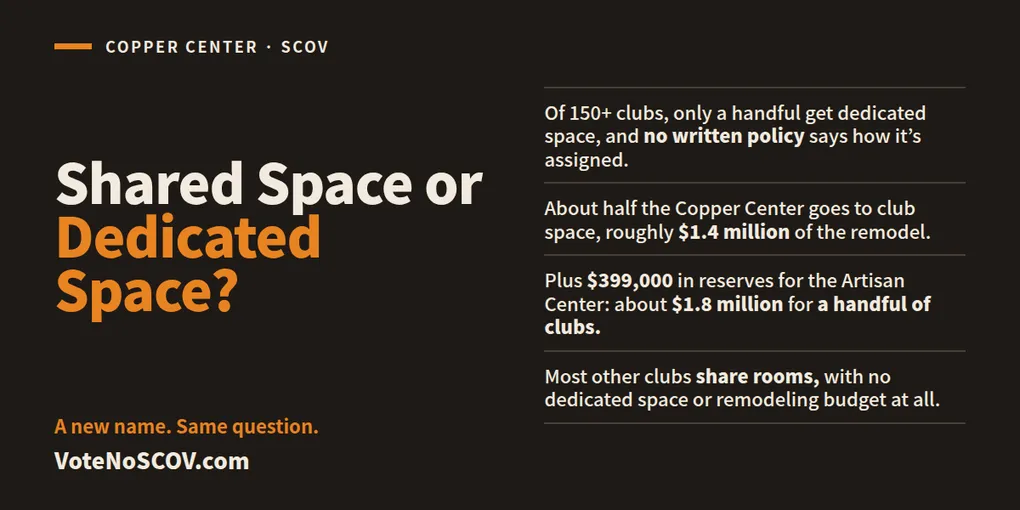
Shared Space or Dedicated Space?
SCOV has more than 150 clubs, but only a handful get dedicated space, and no written policy explains how it’s assigned. Roughly $1.4 million of the $2.78 million Copper Center remodel would go to dedicated club space, plus $399,000 in reserves for the Artisan Center: about $1.8 million for a handful of clubs, while most others share rooms with no dedicated space at all. Before committing millions, the Board should adopt a written policy for assigning dedicated space, applied fairly to every club.
Sun City Oro Valley has more than 150 clubs. Nearly all of them meet in shared rooms, booking time in the Activity Center, Catalina Vista, Desert Oasis, or the Welcome Center alongside everyone else.
Only a few have space set aside just for them.
That’s different from SCOV’s amenities. The golf course, fitness center, pools, library, and restaurant are open to every resident. Some charge fees, but nobody has to join a club to use them.
The Artisan Center is listed on SCOV’s website as an amenity too. But it doesn’t work like one. To use the studios or the equipment, a resident has to join one of the clubs that controls them. In the Board’s 2023 community survey, 47 residents who don’t use the Artisan Center said they would like to, but without having to join a club.
Some activities need dedicated facilities, and nobody expects a woodshop to share space with a book club. But the Copper Center raises a fair question about how those decisions get made.
The artisan clubs already have about 12,500 square feet of dedicated studio space, according to the Long Range Planning Committee’s benchmarking report. The Copper Center would add more.
Of the Copper Center’s 22,675 square feet, only 1,622 are set aside for a community room, plus a 283-square-foot meeting room. Setting aside hallways, restrooms, storage, archives, and space reserved for the future, that’s about 12% of the usable rooms open to all residents. Another 14% goes to the Loan Room and Costume Closet, which serve everyone. The remaining 73%, more than 11,000 square feet, is dedicated to specific clubs. The plan does include space for groups that have been waiting, like Table Tennis, which is a good thing. But most of the building goes to clubs, not to the community at large.
Meanwhile, the Board’s own survey points to a different kind of need. When residents rated their satisfaction with social life in SCOV, the lowest score went to “availability of informal gathering spaces.” And when asked which new amenities mattered most, 55% rated outdoor social gathering areas as important. One resident suggested using the Copper Center for activities “open to all residents, not club use.”
There’s also the question of who benefits financially. Artisans can sell their work through the Gift Shop, and the plan expands it. Members of most other clubs have no comparable opportunity. SCOV’s own club rules say arts and crafts facilities are “not intended to promote or enhance commercial gain.”
Here’s what that looks like in dollars. The Copper Center remodel is estimated at $2,778,000. About half the building, 11,157 square feet, would be dedicated club space. At a flat rate per square foot, that’s roughly $1.4 million of the remodel. On top of that, the Board has earmarked $399,000 in reserves to remodel the Artisan Center for the clubs that stay there.
That’s around $1.8 million directed toward space for a handful of clubs. Most of SCOV’s other 150-plus clubs share rooms, with no dedicated space and no remodeling budget at all.
None of this is a criticism of the artisan clubs. Their members are neighbors, and their work adds a lot to the community. The question is about the process, not the people.
Here’s what owners should know about that process:
SCOV’s club rules explain how shared rooms are scheduled, but say nothing about how a club comes to have dedicated space. Space is allocated “as space allows,” and remodeling requests are evaluated by the General Manager “for program need and funds availability.” There are no published criteria owners can read or apply evenly.
Any chartered club can ask the association to buy major equipment, which then goes on the asset reserve schedule, where all owners pay to replace it. But Board Policy FIN-010 also says clubs are financially responsible for “highly specialized items benefiting only club members.” Studio equipment can only be used by club members, so it’s fair to ask how that rule is being applied.
And access isn’t equal. Club rules require clubs with dedicated space, like pickleball, billiards, and bocce, to set aside at least 25% of their open hours for residents who aren’t members. But spaces behind a coded lock are exempt, and “membership in clubs is required to use these amenities.” The dedicated studios with the most specialized equipment are the ones with no guaranteed access for other residents.
Arizona’s new law on HOA conduct, A.R.S. 33-1821, says associations must use their discretionary powers “neutrally, fairly, without favoritism, and in a nonarbitrary fashion.” Without written criteria, it’s hard for owners to know whether space and equipment decisions meet that standard.
Before the community commits millions to the Copper Center, the Board should adopt a clear, written policy for how dedicated space is assigned, and make sure every dedicated space, locked or not, has time open to all residents.
A new name. Same question.