Check the Record
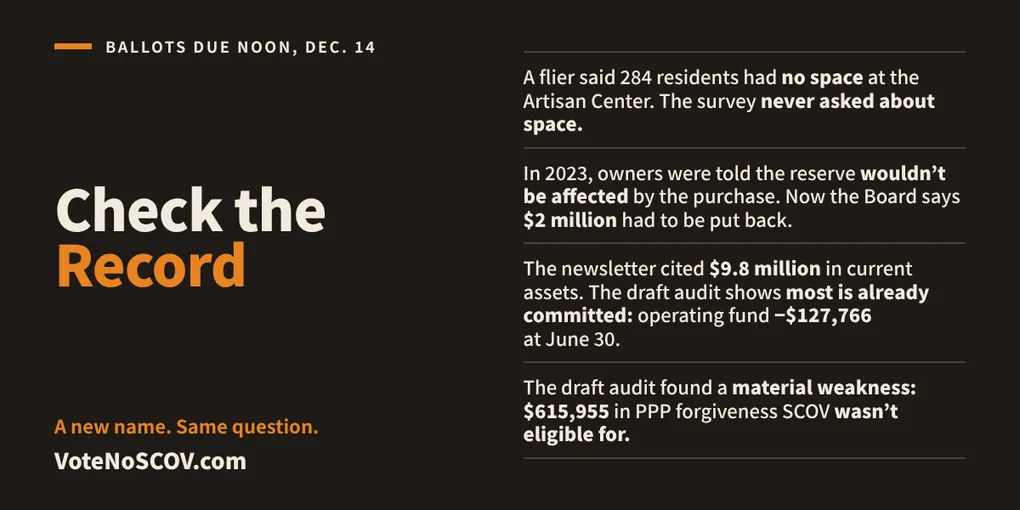
A lot of what’s been said about the Copper Center doesn’t match SCOV’s own records. A Tipster flier said 284 residents had no space at the Artisan Center, but the survey never asked about space. Owners were told in 2023 the reserve wouldn’t be touched by the purchase; the Board’s November newsletter says $2 million had to be put back. The newsletter pointed to $9.8 million in current assets, but the draft audit shows most of it is already committed, with the operating fund at −$127,766 and the capital fund at −$94,939 at June 30. And the auditors found a material weakness: $615,955 in PPP loan forgiveness SCOV wasn’t eligible for. Read the draft audit before you vote. Ballots are due by noon on December 14.
There’s been a lot of Copper Center material going around lately: newsletter items, fliers, presentations. Some of it holds up. Some of it doesn’t match the Association’s own documents. Here are six examples. Sources are listed, so you can look them up yourself.
1. “No space for them”
A Copper Center flier in the Tipster said 284 residents who don’t use the Artisan Center “are interested in using it in the future but the current AC doesn’t have space for them.”
The 2023 survey never asked about space. The answer those 284 people actually chose was “I am interested in trying the Artisan Center in the future.” The most common reason nonusers gave, by far, was “I don’t participate in the crafts at the center,” at 69%. (2023 Community Survey, Amenity and Multi-Use Building Data, page 5)
2. More users than golf or pickleball
The same flier said 664 residents used the Artisan Center, more than golf or pickleball. That counts anyone who went even once that year, and about a third went less than once a month. Look at weekly users and golf comes out ahead, 306 to 260. And when the survey asked what new amenities mattered most, residents put an exercise pool (67%) and a leisure pool (59%) ahead of expanded artisan studios (51%). (2023 survey, pages 5 and 19; 2024 10-Year Development Plan, page 5)
3. The Woodworking Club
A November newsletter said “the Woodworking Club is currently restricting member access due to overcrowding.” The Woodworking Club’s own website says that the wood shop is NOT restricting member access due to overcrowding or for any other reason. (https://www.scovwoodworkingclub.com/news.html)
4. The reserve fund
Before the purchase vote in January 2023, owners were told, “The Asset Reserve Fund will not be impacted by this purchase.”
This November, the Board’s newsletter said that three years ago SCOV “still needed to replenish $2 million to our reserves for the Copper Center purchase.” The 2026-27 budget shows $1 million of last year’s dues going to the capital fund, with a matching $1 million put back into the reserve. (2023 Copper Center Q&A; November 2026 newsletter; 2026-27 budget, 5-Year Plan)
5. “Nearly $9.8 million in Current Assets”
The same newsletter pointed to $9.8 million in current assets as proof SCOV’s finances are sound.
The draft 2025-26 audit, released to homeowners on November 14, shows that at June 30, 2026, current assets were $9,124,939 and current liabilities were $9,459,613. That doesn’t mean SCOV can’t pay its bills. Most of those liabilities are dues paid in advance ($4.1 million) and reserve money set aside for repairs ($4.9 million). But it does mean most of that cash is already committed. The money actually free for other uses is small: the operating fund ended the year at −$127,766 and the capital fund at −$94,939. (Draft 2025-26 audit, balance sheet, pages 4 and 5)
6. “Financial oversight and accountability”
The newsletter also stressed SCOV’s financial oversight. The draft audit found a material weakness, which is the most serious kind of internal control finding auditors make.
In 2021, SCOV recorded $615,955 in PPP loan forgiveness as revenue. As a 501(c)(4) organization, it wasn’t eligible.
The Association repaid the full amount to the U.S. Department of Justice, and as of the report, the matter was under seal and not formally closed. The auditors also flagged a significant risk of errors in transfers between the operating and reserve funds, and listed several mistakes that were corrected, including a reserve liability understated by about $168,000. (Draft 2025-26 audit, Notes 12 and 13, and the auditors’ letters to the Board)
Before You Vote
Owners are being asked for $3.1 million. They should be getting accurate information. Director Olson said on November 5 that owners should see the audited financials before voting. The draft came out nine days later, after the Board approved the ballot and right before ballots go out. Read it first.
Take a look at it before you vote.
Ballots are due by noon on Monday, December 14.
A new name. Same question.